
We track our steps, our sleep, our water intake, but rarely ask who we're moving through life with. Turns out social health might be the most important number of all.
Let’s pull back the curtain on research and what science and soul say about social health that belongs in your flow.
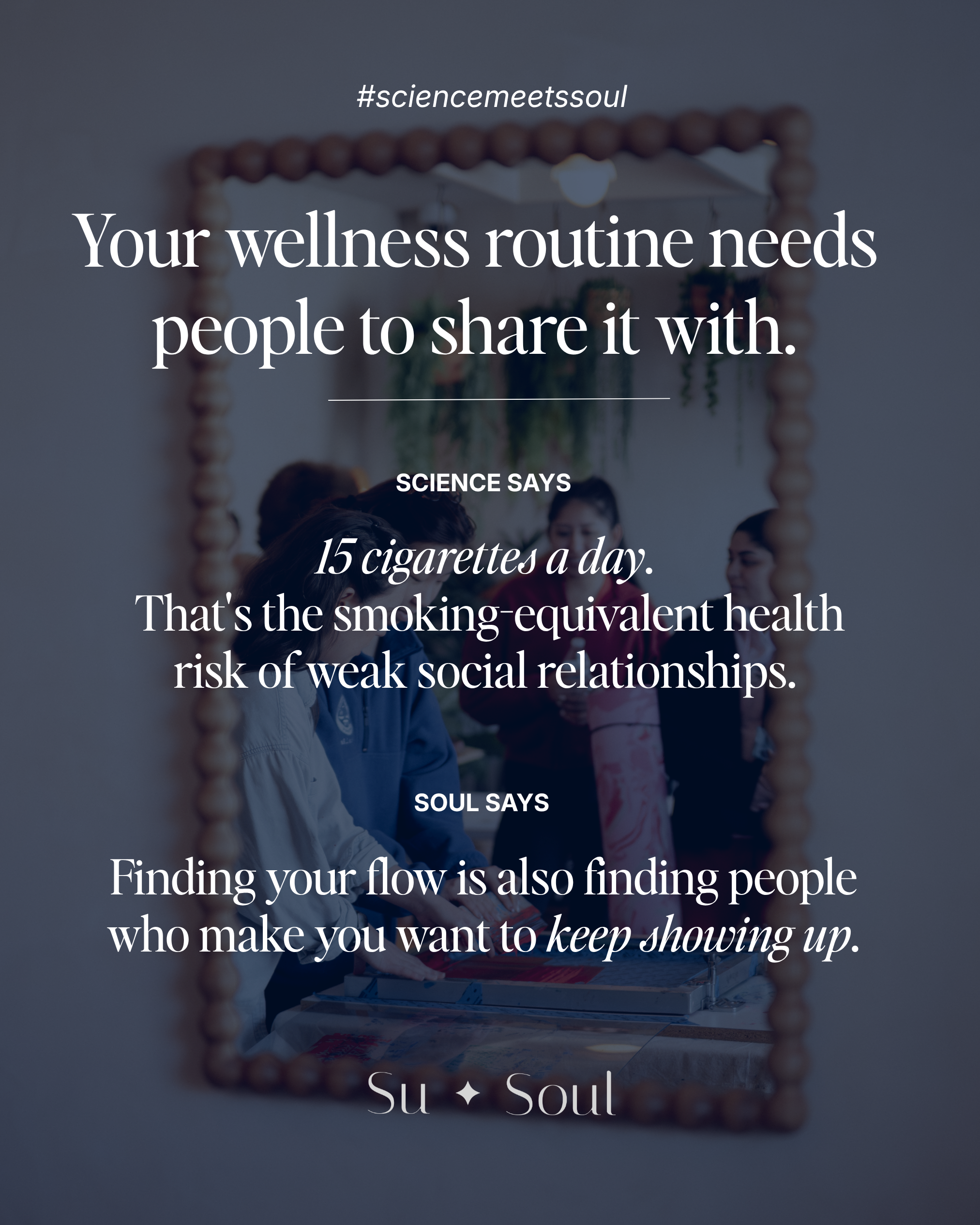
Your wellness routine needs people to share it with.
15 cigarettes a day. That's the smoking-equivalent health risk researchers have found for weak social relationships. It sounds dramatic, but the science behind it is hard to argue with — a landmark meta-analysis found that our social ties influence how long we live about as much as some of the most well-established health risk factors we already take seriously (Holt-Lunstad, Smith, & Layton, 2010)
Weak social connection isn't just an emotional inconvenience. It's a measurable, physical health risk.
Finding your flow was never only about discipline. It's about finding the people who make you want to keep showing up, for the early morning class, for the long walk, for the version of yourself that feels most alive. The routine matters. But the people who make you return to it matter more.
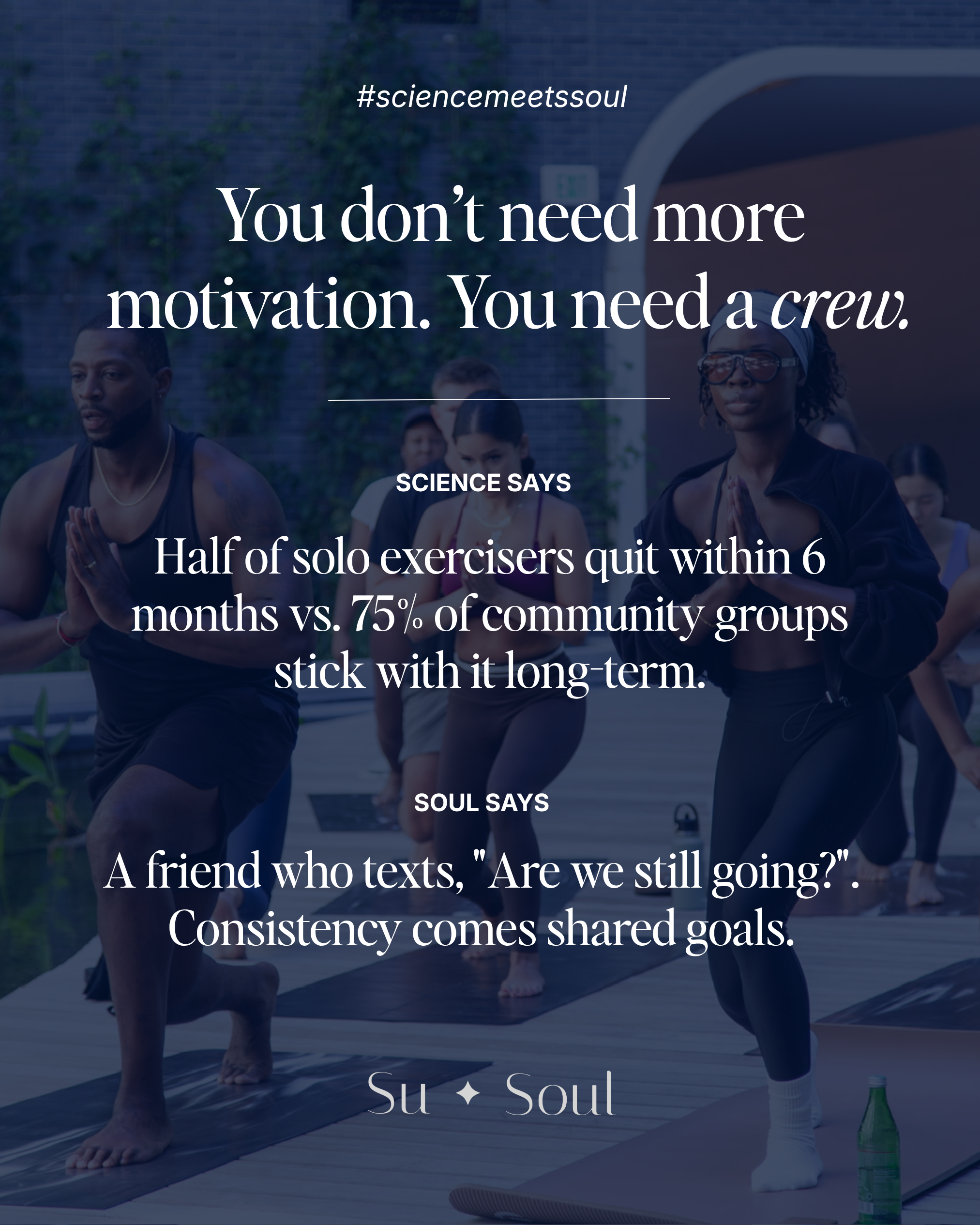
You don’t need more motivation; you need a crew.
Did you know approximately half of people who start an exercise program drop out within the first six months? It's one of the most well-documented patterns in exercise science: motivation gets you started, but it rarely gets you to month seven.
Community changes that equation. Research on community-based group exercise programs has found long-term adherence rates between 69% and 75%, nearly double what's typical for people going it alone (Farrance, Tsofliou, & Clark, 2016; van der Bij et al., 2002)
Why does being in a group make such a measurable difference? A friend who texts "Are we still going?" gives you something willpower alone never can such as shared goals, mutual accountability, and a reason to show up even on the days motivation doesn't.
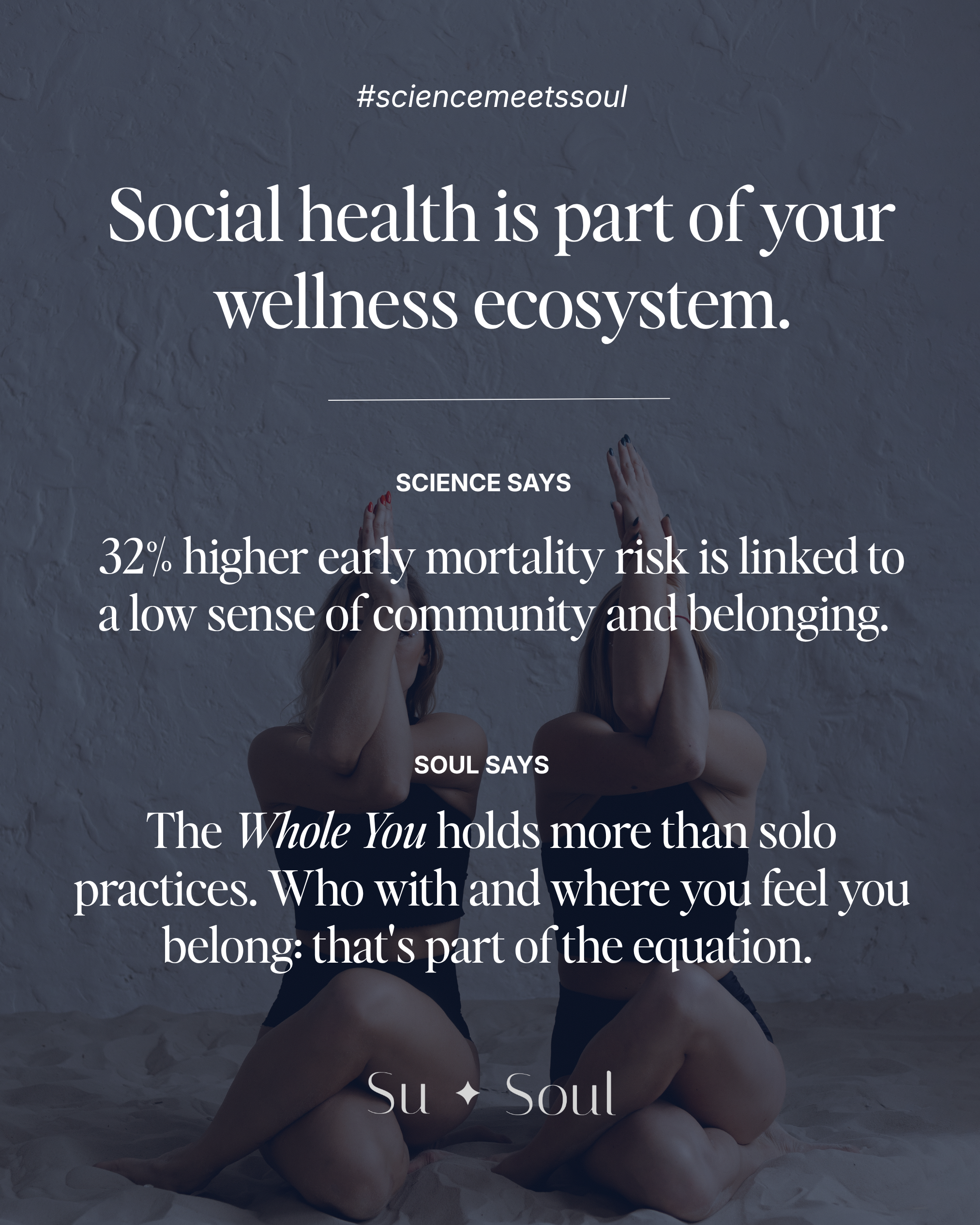
Social health is part of your wellness ecosystem.
Science says a low sense of community and belonging is linked to a 32% higher risk of early mortality. This is a finding that held even after researchers controlled for other health factors like age, illness, and socioeconomic status (Holt-Lunstad, Smith, Baker, Harris, & Stephenson, 2015). It's a striking number, especially considering how rarely belonging shows up on anyone's wellness checklist next to sleep or nutrition.
The Whole You holds more than solo practices. It's not only what you eat, how you move, or how well you sleep, it's who you do those things with, and where you feel like you belong. Community isn't a bonus layered on top of wellness. It's part of the ecosystem itself.
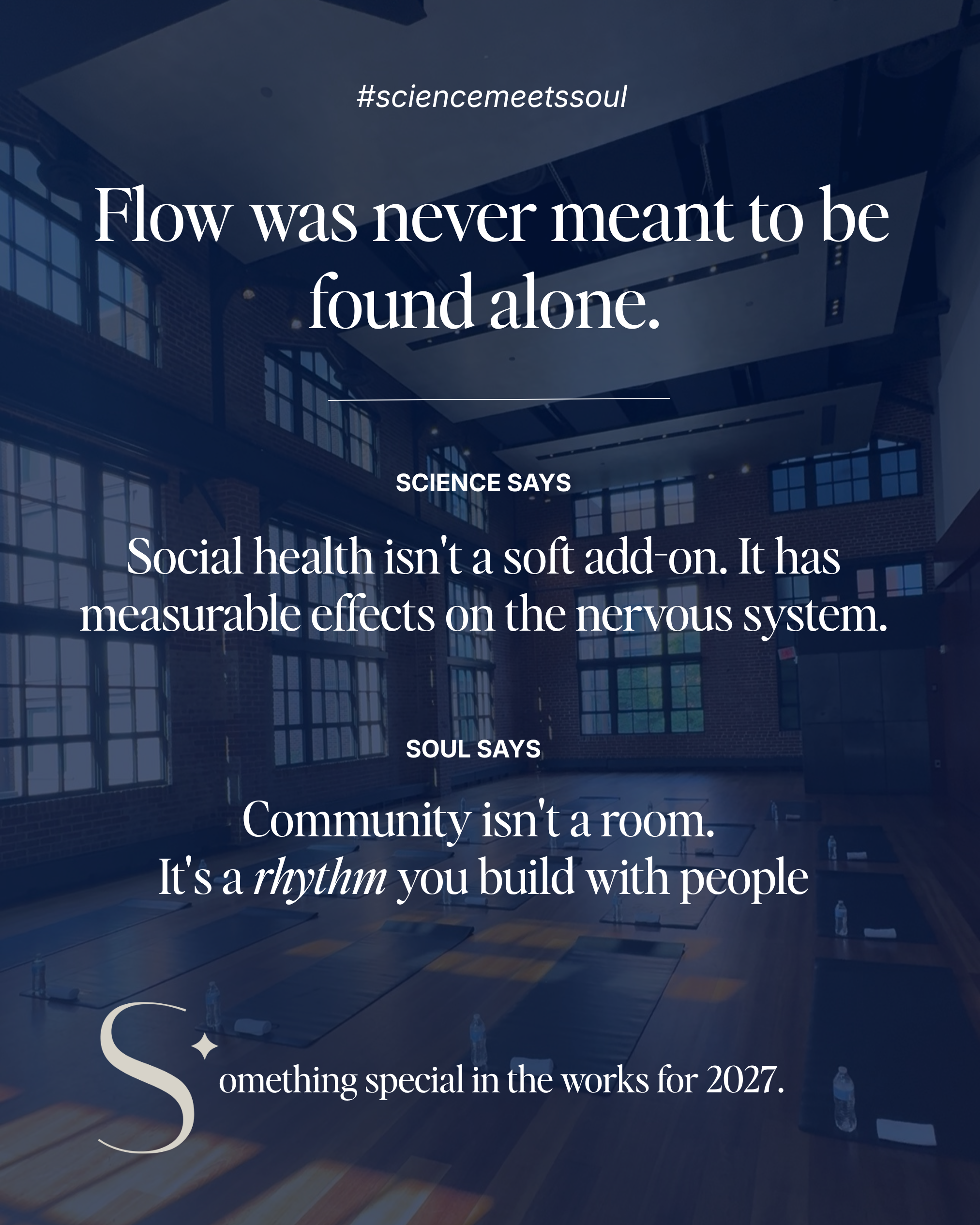
Flow was never meant to be found alone.
Social health isn't a soft add-on to wellness. It has measurable effects on the nervous system. The people you move with, laugh with, and show up for are doing more for your body's stress response than any solo routine can do on its own. Regulation doesn't only happen through breathwork or sleep. It happens in connection, too.
Community is more than a room, a location, or even a single group of people. It's a rhythm. It’s something you build over time, together, through the small consistent act of showing up for each other. Whether that's on the same mat or a thousand miles apart, the rhythm is what makes it real.
Something exciting in the works.
We're building Su + Soul Circle, a recurring rhythm built around consistency and flexible accountability. Circle will bring live virtual classes, your flow map, resources, workshops, and masterclasses into one recurring space, so you always have somewhere to return to and people to return with.
The First Wave launches in 2027. The waitlist is open now! Join before it’s live, and lock in a significant early-member discount.
References
Farrance, C., Tsofliou, F., & Clark, C. (2016). Adherence to community-based group exercise interventions for older people: A mixed-methods systematic review. Preventive Medicine, 87, 155–166.
Holt-Lunstad, J., Smith, T. B., Baker, M., Harris, T., & Stephenson, D. (2015). Loneliness and social isolation as risk factors for mortality: A meta-analytic review. Perspectives on Psychological Science, 10(2), 227–237.
Holt-Lunstad, J., Smith, T. B., & Layton, J. B. (2010). Social relationships and mortality risk: A meta-analytic review. PLOS Medicine, 7(7), e1000316.
van der Bij, A. K., Laurant, M. G. H., & Wensing, M. (2002). Effectiveness of physical activity interventions for older adults: A review. American Journal of Preventive Medicine, 22(2), 120–133.